Wednesday, January 24, 2007
Internet Writing Workshop
So I don't post for a month, and nobody notices? What's up with that? Well, never mind. No offense taken. Meanwhile, may I commend you to the Internet Writing Workshop, a superb online venue where writers critique each others' work in a safe and friendly environment. They have a variety of mailing lists where you can submit your work for critique. It's open to writers of all skill levels, and it's quite well run by dedicated volunteers. No flamers allowed.

Thursday, December 21, 2006
A public reading
Last night was my first public event, a book reading and signing at the Branigan Library in Las Cruces. In addition to Mike from Coas Bookstore, there were nine folks in the audience, and they bought five copies of my book. It was great--I felt comfortable with a friendly audience, and they reacted quite well to chapter 1.
Friday, December 15, 2006
Check out Moni's Nook

My friend Moni from India asked me to send her remarks about When Pigs Fly so she could post them on her blog, Moni's Nook. She has interesting insights into life and writing, and you may enjoy checking them out.
Friday, December 08, 2006
An unexpected reader
I tend to be quiet among relatives and non-writing friends about my passion for writing. So when my former neighbors in Massachusetts heard that I'd published a novel, they seemed quite surprised. My wife's 101-year-old grandmother just called the other day, expressing delight and saying she intends to buy the book. We'll just send her a copy as a gift, my wife said. No, no, she said, she wants to buy it. Barbara and I have been acquainted for about 45 years, and she said she had no idea that I wrote fiction. If you write, you may know that squeamish feeling you get when you tell someone that you write novels but haven't been published yet. Oh, folks are nice about it, but no one ever seems surprised that I'm not fighting for bookstore shelf space with King and Grisham.
Barbara is a wonderful lady, a Holyoke College Phi Beta Kappa from the 1920s who recently told us she's surrounded by too many old people at her assisted living facility in Vermont. She is blind now, and one of her many friends will have to read the book aloud to her. This leaves me a little apprehensive; of course she has never heard me swear or utter anything inappropriate, so I hope my book doesn't shock her.
That is what happens when you put your work out for the world to see, though, isn't it?
Barbara is a wonderful lady, a Holyoke College Phi Beta Kappa from the 1920s who recently told us she's surrounded by too many old people at her assisted living facility in Vermont. She is blind now, and one of her many friends will have to read the book aloud to her. This leaves me a little apprehensive; of course she has never heard me swear or utter anything inappropriate, so I hope my book doesn't shock her.
That is what happens when you put your work out for the world to see, though, isn't it?
Wednesday, November 22, 2006
Notes from a writer's conference, part 3
The final session of the Pitch, Publish and Promote conference covered promotion, and Jerry Simmons of WritersReaders gave a fine presentation. Jerry is not a writer, but has been in the publishing and promotion business for a lot of years.
Publishing is a business. Think of it that way, and you'll succeed as a writer.
Key concept: Sell-through. This is the ratio of books sold versus books shipped, so if the publisher ships 1000 copies to retailers and 400 copies are returned unsold, the sell-through is 60%. A minimum acceptable ratio is 60%; a lower rate is very bad.
If the publisher ships 500,000 copies of your book, that sounds fantastic. But if you sell only 200,000 copies, your book is a disaster. You are far better off as a writer if only 50,000 copies ship and 30,000 sell. It may sound counterintuitive, but the sell-through rate is critical. A 50% sell-through will doom a writer's future, no matter how many copies actually sell. What a writer should want is a low initial ship rate. It's much better if the book requires a second printing.
Writers need to know this type of thing, because many publishers will cynically screw over the writers. But if you can speak the language of the publishing business, they are much more likely to treat you with respect.
You need to separate yourself and your book from everything else being published.
90% of revenue is generated from 10% of the titles.
At least 500 titles are published daily.
Develop relationships with decision makers who can help you sell your book. It helps to know someone in the publishing business.
If you are a self-published author, you will be sure to get publishers' attention by selling a few thousand copies.
Publishers also want to be able to sell your earlier published titles--this is the back list.
Visit and observe what's in book stores.
Write on a schedule.
Use small focus groups to evaluate what works in your writing.
Ingram and Baker & Taylor are big jobbers, or distributors.
Writers should look at these independents for possible distribution:
The market for audio books hasn't grown in 10 years, but the market still exists.
Best opportunities to focus:
Publishing is a business. Think of it that way, and you'll succeed as a writer.
Key concept: Sell-through. This is the ratio of books sold versus books shipped, so if the publisher ships 1000 copies to retailers and 400 copies are returned unsold, the sell-through is 60%. A minimum acceptable ratio is 60%; a lower rate is very bad.
If the publisher ships 500,000 copies of your book, that sounds fantastic. But if you sell only 200,000 copies, your book is a disaster. You are far better off as a writer if only 50,000 copies ship and 30,000 sell. It may sound counterintuitive, but the sell-through rate is critical. A 50% sell-through will doom a writer's future, no matter how many copies actually sell. What a writer should want is a low initial ship rate. It's much better if the book requires a second printing.
Writers need to know this type of thing, because many publishers will cynically screw over the writers. But if you can speak the language of the publishing business, they are much more likely to treat you with respect.
You need to separate yourself and your book from everything else being published.
90% of revenue is generated from 10% of the titles.
At least 500 titles are published daily.
Develop relationships with decision makers who can help you sell your book. It helps to know someone in the publishing business.
If you are a self-published author, you will be sure to get publishers' attention by selling a few thousand copies.
Publishers also want to be able to sell your earlier published titles--this is the back list.
Visit and observe what's in book stores.
Write on a schedule.
Use small focus groups to evaluate what works in your writing.
Ingram and Baker & Taylor are big jobbers, or distributors.
Writers should look at these independents for possible distribution:
The market for audio books hasn't grown in 10 years, but the market still exists.
Best opportunities to focus:
- Tap into online sales.
- Specialty groups--organizations, groups, book clubs (Google this). This is bigger than the traditional marketplace. You might sell quantities of your book to an organization at a discount, and let them sell at list.
But don't neglect traditional bookstores.
Jerry Simmons has a free newsletter. See his website for this.
Ways to sell your book:
- Advertising
- Promotion--drawing attention to your book.
- Publicity--by far the most effective--any attention you can get for free. This can be about the author as well as about the book. Find some kind of newsworthy tie-in.
The five biggest weaknesses of publishers:
- They don't think outside the mainstream, so the specialty book market is growing at their expense.
- They don't gather information on who is buying their books. Writers should do this--know who is buying their books.
- They sell to the masses and miss the niche markets.
- They don't sell on the Internet, because they are afraid of alienating Amazon and Barnes and Noble. The Internet is the next big platform for writers.
- They tend to hit only the 30 biggest media markets.
Self-published authors should stay away from competition in the major markets.
An author should expect to make $0.60 or $0.70 profit from each sale of a book published by a NY publisher.
Publishers tend to dislike working with writers who write in multiple genres. If you do it, you should consider using a pen name.
Marketing success depends on persistence. 99.9% of authors don't know this stuff.
Tuesday, November 21, 2006
Notes from a writer's conference, part 2
Here are more of my notes from the Pitch, Publish and Promote conference. I've made no attempt to put these into a narrative, but I think they'll still convey worthwhile information.
The second part featured Bob Sanders, CEO of Mundania Press, which he co-founded to republish the works of Piers Anthony. They publish paranormal fiction. He says that to check the process, he has anonymously submitted work to his own company and been rejected.
It's critical for you as a writer to know your audience. What are their reading tastes? (Genre is a starting point.) What else does the market read? What kind of disposable income do they have? It's not enough to say your audience consists of adult males over 25.
A writer needs a business plan and a marketing plan. The business plan can be brief. Try to write it before finishing your novel.
A publisher looks for a reason to say no. The quickest way to get rejected at Mundania is to not follow submission guidelines.
You should have a critique partner, someone who knows the genre you're writing in.
Market like it's your last day on earth.
The publisher sells the book to book buyers.
The author has to market the book to the reading public.
Use Yahoo groups to set up a small focus group to test your work.
An author's business plan should encompass not just one book, but your writing career. Who will sell your books? Who is your fan base? What media will you use to reach them? What is your vision for your writing career? Answer the Who, What, Where, When, Why, How.
Set your expectations for a given time frame. How much time do you realistically have to write?
Think about why the audience should care about your books? Why should they enjoy them?
Your marketing plan deals with the individual books.
Set objectives--what do you want to accomplish? Three objectives you want to accomplish within a year, for example. Share this plan with friends and family.
Need to set measureable goals--describe the activity required, what will happen and when, and what is the expected financial impact.
An author needs visibility and mystique (referring to how the person appears to the public). Look the part for the type of author you are and the type of business personality that's appropriate for the kind of writing you do.
Where to find customers:
The second part featured Bob Sanders, CEO of Mundania Press, which he co-founded to republish the works of Piers Anthony. They publish paranormal fiction. He says that to check the process, he has anonymously submitted work to his own company and been rejected.
It's critical for you as a writer to know your audience. What are their reading tastes? (Genre is a starting point.) What else does the market read? What kind of disposable income do they have? It's not enough to say your audience consists of adult males over 25.
A writer needs a business plan and a marketing plan. The business plan can be brief. Try to write it before finishing your novel.
A publisher looks for a reason to say no. The quickest way to get rejected at Mundania is to not follow submission guidelines.
You should have a critique partner, someone who knows the genre you're writing in.
Market like it's your last day on earth.
The publisher sells the book to book buyers.
The author has to market the book to the reading public.
Use Yahoo groups to set up a small focus group to test your work.
An author's business plan should encompass not just one book, but your writing career. Who will sell your books? Who is your fan base? What media will you use to reach them? What is your vision for your writing career? Answer the Who, What, Where, When, Why, How.
Set your expectations for a given time frame. How much time do you realistically have to write?
Think about why the audience should care about your books? Why should they enjoy them?
Your marketing plan deals with the individual books.
Set objectives--what do you want to accomplish? Three objectives you want to accomplish within a year, for example. Share this plan with friends and family.
Need to set measureable goals--describe the activity required, what will happen and when, and what is the expected financial impact.
An author needs visibility and mystique (referring to how the person appears to the public). Look the part for the type of author you are and the type of business personality that's appropriate for the kind of writing you do.
Where to find customers:
- Workshops/associations
- Newspapers/publishers/coalitions
- Referrals
- Internet/TV/radio
- Trade journals
Considerations in thinking about your potential customers:
- Age
- Gender
- Location
- Income/occupation/education
- Purchasing loyalty
- Hobbies
- Social class/lifestyle
Think about how you'll promote to the top three categories of readers.
A question he posed over and over: "Is the juice worth the squeeze?" Always consider whether any given effort is worth the expected result.
Make use of Google and Yahoo. Leverage your resources.
List the problems you're facing:
- What's the root cause?
- What needs to change?
- How will I measure results?
Hold online writing workshops, as does paranormal author Michele Bardsley.
Authors can coordinate group ads.
Find and develop a niche.
Planning
Plan on the specific actions you intend to accomplish, then do it. ("Plan the work, work the plan.") Say how you'll do something and why--specific tasks that will affect the bottom line.
Think about where your time and attention are going.
Regularly re-evaluate your plans. Treat your writing like a business.
Don't give the public too much information about yourself.
Mentioned: Fictionwise
Monday, November 20, 2006
Notes from a writer's conference, part 1
I just came back from the Pitch, Publish and Promote conference in Albuquerque, which lasted a day and a half and was organized by SouthWest Writers. Over the next few days, I will post some of my notes.
The pitching segment featured a talk by Katharine Sands, a New York literary agent who offered plenty of advice on how to approach agents. She tossed around lots of arcane-sounding terms such as "dysfiction," which I didn't find all that useful, so I didn't write them all down.
She distinguishes between a writer and an author; the latter is a published writer. Writing is solitary, while publishing is collaborative.
A manuscript does not become a book until it is published. Never refer to your manuscript as "complete."
When querying agents for non-fiction (I think she meant for fiction as well), don't just give the facts of your story. You should show your voice and provide a lens that lets us see into the book.
Don't pitch multiple ideas at once. Just one at a time.
A query is a one-page pitch. Nobody reads two pages. The query must "infotain," provide a spark, give the agent a memorable takeaway nugget.
In your query, lead with what is the most interesting. Don't waste your first paragraph.
Elevator pitch: about 25 words to grab the agent's attention.
Your pitchcraft becomes your jacket copy, your hook.
Agents are looking for voice, elements, alchemy.
Good news/bad news: The good news is that talent comes from everywhere, and agents are always on the lookout. The bad news is that the agents are flooded with queries.
Talk about your platform in your query letter, if warranted. If you are a recognized expert in the field you're writing about, for example, be sure to let the agent know. Also, tell how your other writing has been noticed, how you will get readers, or anything that makes your work interesting or different.
Agents do not log submissions. If you don't get a reply, sometimes you can get away with waiting a while and querying again.
Radio sells more books than television.
Categories of published books:
Front List: Books by the very top authors, whose work automatically stands out in the market place.
Mid List: Where most work ends up. This is a very wide range.
Back List: Books that are not ordinarily marketed in bookstores except under special circumstances. They might be specialty books, or they might be earlier books in a series. So if the latest Harry Potter book comes out, bookstores might also trot out all of Rowling's earlier titles to try selling those at the same time. Those earlier titles have been back listed.
Booksellers don't buy books. They take them on consignment.
Book buyers frequently get to retitle a book if they think the original title won't sell.
A good query might wind up becoming the catalog description.
As an author, you must be an impassioned ambassador for your work.
Generally okay to query multiple agents at once.
You can often find the names of literary agents on the acknowledgement pages of recently published books.
The Preditors & Editors website is a good place to learn what some of the shadier folks in the business may not want you to know.
The pitching segment featured a talk by Katharine Sands, a New York literary agent who offered plenty of advice on how to approach agents. She tossed around lots of arcane-sounding terms such as "dysfiction," which I didn't find all that useful, so I didn't write them all down.
She distinguishes between a writer and an author; the latter is a published writer. Writing is solitary, while publishing is collaborative.
A manuscript does not become a book until it is published. Never refer to your manuscript as "complete."
When querying agents for non-fiction (I think she meant for fiction as well), don't just give the facts of your story. You should show your voice and provide a lens that lets us see into the book.
Don't pitch multiple ideas at once. Just one at a time.
A query is a one-page pitch. Nobody reads two pages. The query must "infotain," provide a spark, give the agent a memorable takeaway nugget.
In your query, lead with what is the most interesting. Don't waste your first paragraph.
Elevator pitch: about 25 words to grab the agent's attention.
Your pitchcraft becomes your jacket copy, your hook.
Agents are looking for voice, elements, alchemy.
Good news/bad news: The good news is that talent comes from everywhere, and agents are always on the lookout. The bad news is that the agents are flooded with queries.
Talk about your platform in your query letter, if warranted. If you are a recognized expert in the field you're writing about, for example, be sure to let the agent know. Also, tell how your other writing has been noticed, how you will get readers, or anything that makes your work interesting or different.
Agents do not log submissions. If you don't get a reply, sometimes you can get away with waiting a while and querying again.
Radio sells more books than television.
Categories of published books:
Front List: Books by the very top authors, whose work automatically stands out in the market place.
Mid List: Where most work ends up. This is a very wide range.
Back List: Books that are not ordinarily marketed in bookstores except under special circumstances. They might be specialty books, or they might be earlier books in a series. So if the latest Harry Potter book comes out, bookstores might also trot out all of Rowling's earlier titles to try selling those at the same time. Those earlier titles have been back listed.
Booksellers don't buy books. They take them on consignment.
Book buyers frequently get to retitle a book if they think the original title won't sell.
A good query might wind up becoming the catalog description.
As an author, you must be an impassioned ambassador for your work.
Generally okay to query multiple agents at once.
You can often find the names of literary agents on the acknowledgement pages of recently published books.
The Preditors & Editors website is a good place to learn what some of the shadier folks in the business may not want you to know.
My novel is published!
My comic novel, When Pigs Fly, is published and available through my website, iUniverse and Amazon. Exciting stuff! I noticed that Powells has it as well, but their price looks too high, three bucks over list. Also, B&N doesn't seem to have the title yet.
Meanwhile, my friend Bev tells me she just received her copy in the mail. That makes it seem more real.
Meanwhile, my friend Bev tells me she just received her copy in the mail. That makes it seem more real.
Monday, October 23, 2006
Free bookmark

Here's a promotional bookmark I created, now that I know the price and page count of the book. If you would like to have a free bookmark, send me an email (bobsanchez1@comcast.net) with your name and address. I will gladly send you one, wherever you are in the world.
iUniverse ran into a couple of production delays recently, but they are working hard to get back on track. I'm still hoping for the book to be available by early December. We shall see.
Saturday, October 14, 2006
A reflection on duct tape
The online pub Laughter Loaf just accepted my short piece, You Can't Be Too Careful, a reflection on the importance of duct tape. It's on their docket for May 15, 2007, so we'll all have to hold our collective breaths until then.
Ready? Take a deep breath and hold it...
Seriously, I'm pleased.
Ready? Take a deep breath and hold it...
Seriously, I'm pleased.
Monday, October 09, 2006
An endorsement
The other day, well-known author Leslie Meier (The Lucy Stone Mystery Series) offered this praise of When Pigs Fly:
"Bob Sanchez hits all the right notes in this zany comedy that will keep you turning the pages -- and laughing out loud!"
Thanks, Leslie!
"Bob Sanchez hits all the right notes in this zany comedy that will keep you turning the pages -- and laughing out loud!"
Thanks, Leslie!
Sunday, October 08, 2006
Poetic lament
I entered a haiku contest sponsored by a Japanese organization, and months later received the sad news that they saw through my lack of poetic talent. Herewith my lament:
Rejected haiku
Seven hundred others won
Hara kiri looms.
Rejected haiku
Seven hundred others won
Hara kiri looms.
Monday, October 02, 2006
The cover
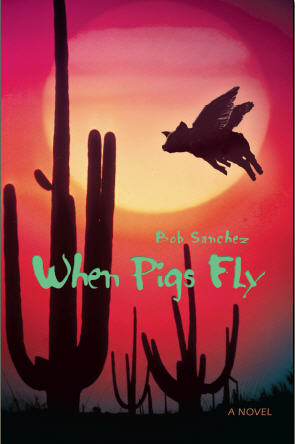
My cover design came in today, and I'm quite pleased with it! Here is what it looks like. People do just books by their covers, and I think this one conveys a sense of humor without appearing to be a children's book.
The next step in the process is to review a proof, which I hope to get soon. I've already gone over the text time and again, so there shouldn't be (m)any typos.
Thursday, September 21, 2006
Proofread your work!
I recently read a mystery published by a small press--let's keep names and titles out of this gripe. The writing was fine in many respects; the chapters were short, the pacing was excellent, the characters were sympathetic. The plot and dialogue worked well.
So why mention it? Because apparently no one proofread the manuscript. Wouldn't you think that if a novel is about a kidnapping, that someone would notice that there are supposed to be two p's in kidnapped? It's spelled wrong dozens of times, because no one thought to look up the word. Frequently the author is too close to catch these errors, but someone should catch them before the reader does. Running a spell-check program would have caught "kidnaped" or "kidnaping." Even the spell-checker is not sufficient, but it should be a writer's first line of defense.
Typos--at least typos in quantity--distract from my enjoyment of a book and from my appreciation of its author.
So why mention it? Because apparently no one proofread the manuscript. Wouldn't you think that if a novel is about a kidnapping, that someone would notice that there are supposed to be two p's in kidnapped? It's spelled wrong dozens of times, because no one thought to look up the word. Frequently the author is too close to catch these errors, but someone should catch them before the reader does. Running a spell-check program would have caught "kidnaped" or "kidnaping." Even the spell-checker is not sufficient, but it should be a writer's first line of defense.
Typos--at least typos in quantity--distract from my enjoyment of a book and from my appreciation of its author.
Wednesday, September 13, 2006
The cover in progress

This week, an iUniverse graphic artist is designing the cover for When Pigs Fly. My idea had been to show a silhouette of a pig or javelina flying over Arizona's Sonoran Desert at sunset. There are several children's books by the same name, so I stressed the importance of designing the cover to appeal to adults. They referred me to several stock photographs that they could work with.
I didn't much care for the pig they found, which looked vaguely creepy. So I found a more suitable one and superimposed it on the sunset. The graphic artist should be using something like the image on the right. They plan to use a Nueva font with a drop shadow for the title and my byline. This doesn't look like a children's book to my friends who've seen it, so that's a relief.
Thursday, August 31, 2006
It's done!
Glory, hallelujah, I've declared my manuscript complete and sent it to iUniverse. For the last week I've been going over the story, picking out the nits. Did you know that heaven and hell aren't initial-capped? Nor are pronouns referring to deities. So I had to change "God sure took His time, didn't He?" to "God sure took his time, didn't he?" The estimable editors at iUniverse referred me to the Chicago Manual of Style, and sure enough, they were right. I've been making little changes like that 'til my eyes were about to fall out, so the copy should be clean.
I've often heard stated as a truism that a writer can't edit his own writing. Well, I just did it, though it helped a lot that iUniverse sent me a report telling me the types of issues to look for.
Soon I hope to hear from iUniverse graphics folks about the cover art.
I've often heard stated as a truism that a writer can't edit his own writing. Well, I just did it, though it helped a lot that iUniverse sent me a report telling me the types of issues to look for.
Soon I hope to hear from iUniverse graphics folks about the cover art.
Tuesday, August 22, 2006
The Pig's Progress
Right now I'm going line by line through When Pigs Fly, and that's a slow process. Sixty-eight pages in three days, and only 150 pages to go. Then I'll ship my edits off to iUniverse and move on to the next step. They have to put the book into the production queue, and they owe me a cover design, which I am eager to see.
Sunday, July 30, 2006
Advance praise for When Pigs Fly
Here is what a couple of well-regarded published authors have to say about my upcoming novel:
Bob Sanchez’s When Pigs Fly reads like it was written with an ice pick, and he drives it right into the heart of the American dream of the Golden Years. A big pay-out lottery ticket, a 300-pound bad guy named Diet Cola, an Elvis Impersonator, and a javelina that flies? No one looking for a smooth Southwestern retirement should have to face what Mack Durgin faces. Part road trip, part crime caper, part love story, this is one cool debut. If you like the dark comedy of Hiaasen and Leonard, you’re going to love this one.
David Daniel, award-winning author of The Marble Kite and Reunion
When Pigs Fly is a masterpiece of comic writing combined with a touching story. Quirky doesn’t begin to describe the characters—they’re sometimes terrifying, often hilarious, and always unique. Robert Sanchez has the perfect touch for comedy, delivering a riotous good time while giving us a well-developed protagonist we’ll want to follow for many books to come.
Kathryn Mackel, author of The Hidden
Bob Sanchez’s When Pigs Fly reads like it was written with an ice pick, and he drives it right into the heart of the American dream of the Golden Years. A big pay-out lottery ticket, a 300-pound bad guy named Diet Cola, an Elvis Impersonator, and a javelina that flies? No one looking for a smooth Southwestern retirement should have to face what Mack Durgin faces. Part road trip, part crime caper, part love story, this is one cool debut. If you like the dark comedy of Hiaasen and Leonard, you’re going to love this one.
David Daniel, award-winning author of The Marble Kite and Reunion
When Pigs Fly is a masterpiece of comic writing combined with a touching story. Quirky doesn’t begin to describe the characters—they’re sometimes terrifying, often hilarious, and always unique. Robert Sanchez has the perfect touch for comedy, delivering a riotous good time while giving us a well-developed protagonist we’ll want to follow for many books to come.
Kathryn Mackel, author of The Hidden
Saturday, July 22, 2006
Great news! Pigs really fly!
We're finally settled in Las Cruces and don't have a moment's regret. New Mexico is flat-out beautiful. I haven't begun any new projects, but am thrilled that my comic novel When Pigs Fly will be published by iUniverse this fall. As most folks probably know, iUniverse is a print-on-demand proposition where virtually all of the marketing effort is the responsibility of the author. So if I don't work hard to promote my precious pig, he sinks like a bucket of lard. However, I've heard good things about iUniverse from folks who know what to expect of them.
Since I took the plunge yesterday, I've reserved the domain www.bobsanchez.com, which forwards to my existing personal home page. Once there is decent artwork and a publication schedule, I'll change that page to advertise the book.
I've also solicited several published writers for cover blurbs and have arranged for a Kirkus Discoveries review. The deal is that for a fee, Kirkus reviews a book they wouldn't ordinarily review, such as a POD. They stress caveat emptor, meaning what you pay for is an honest review. It's worth taking the chance, as a review from them means increased visibility.
The whole idea of Kirkus charging money for reviews raises questions in some people's minds, my own included. Will they go easy in reviews that writers pay for? If you're curious, check out some of the Kirkus Discovery reviews on the link I provided above. It's unclear whether they will carry the same cachet as the traditional Kirkus reviews, but I certainly hope so.
Since I took the plunge yesterday, I've reserved the domain www.bobsanchez.com, which forwards to my existing personal home page. Once there is decent artwork and a publication schedule, I'll change that page to advertise the book.
I've also solicited several published writers for cover blurbs and have arranged for a Kirkus Discoveries review. The deal is that for a fee, Kirkus reviews a book they wouldn't ordinarily review, such as a POD. They stress caveat emptor, meaning what you pay for is an honest review. It's worth taking the chance, as a review from them means increased visibility.
The whole idea of Kirkus charging money for reviews raises questions in some people's minds, my own included. Will they go easy in reviews that writers pay for? If you're curious, check out some of the Kirkus Discovery reviews on the link I provided above. It's unclear whether they will carry the same cachet as the traditional Kirkus reviews, but I certainly hope so.
Friday, June 02, 2006
Homeless in our Volvo
We close on our house sale this coming Monday, but mentally we've already closed; in fact, we are 900 miles away in our Volvo stuffed with luggage, laptops, a camera, and two cats with all the attendant paraphernalia that implies.
This is day 2 of our trip from Massachusetts to our new home in New Mexico, where we close in a couple of weeks. So break out the violins--we'll be homeless in our Volvo.
 We won't do much sightseeing because of our cats, but we did go through the Shenandoah Valley today, which was wonderful even with the cloud cover. This graceful doe posed for us along Skyline Drive.
This is day 2 of our trip from Massachusetts to our new home in New Mexico, where we close in a couple of weeks. So break out the violins--we'll be homeless in our Volvo.
 We won't do much sightseeing because of our cats, but we did go through the Shenandoah Valley today, which was wonderful even with the cloud cover. This graceful doe posed for us along Skyline Drive.
Subscribe to:
Posts (Atom)


 Posts
Posts