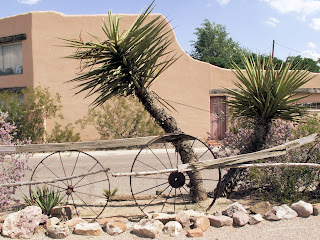
Outside El Comedor Restaurant, where the Mesilla Valley Writers fiction group meets
When I sent a copy of
When Pigs Fly to book reviewer Floyd Orr, little did I know that he would submit five separate reviews to five different publications. Since he’s given me permssion to use them as I see fit, I’m posting them here. Many thanks to Floyd for all the thought and effort he put into these reviews.
The Authors Den Review
Bob Sanchez has chosen a delightful set of colorful characters to indulge the reader’s imagination in his first novel. I cannot accurately portray the imagery in my mind while I read
When Pigs Fly without mentioning the black comedy movie,
Raising Arizona. As in that legendary comic adventure, many of the most entertaining characters in
When Pigs Fly are petty criminals, and it may not be a coincidence that most of the action takes place in Arizona. Mr. Sanchez had a long career as a technical writer, and he has stated that he spent considerable time in a writers’ group, too. All those years of practice are evident in Mr. Sanchez’ first foray into the entertainment novel genre. The editing is tight, the typos are minimal, and the dialog is appropriately ungrammatical for a bunch of sleazy, uneducated characters.
When Pigs Fly is not a long, heavy, or serious book. It’s a romping summer lark with a retired Yankee cop, his brand-new girlfriend, a little pet pig you will come to love, even though he’s stinky, and a pair of thieves who are about as competent as the two in the movie,
Home Alone!
The Blogger News Net Review
If you’re looking for a light, quick, entertaining, summer read,
When Pigs Fly is an excellent choice. Retired technical writer Bob Sanchez has released his first novel and it’s a slam-bang hoot with the offbeat energy of
Raising Arizona raging through its pages. In fact, most of the action takes place in Arizona, and that’s not a bad coincidence at all.
The storyline is both twisted and convoluted, so try to stay with me here. Since I never give away any more of a book’s plotline than I as a consumer would want to read in a review, the following description is merely the beginning. An eighty-year-old couple in Lowell, MA, buys a lottery ticket with the jackpot numbers printed right on it. A stinky, three-hundred-pound, sleazebucket thief steals the ticket, but he does not put it in his pocket. The thief has already been sentenced to a time of less than one year for a previous conviction, and the ticket is good for a year. Instead of cashing it in immediately, he hides the ticket inside an urn in the couple’s house, planning to retrieve it after serving his time. Little does he know that the urn contains the ashes of a dead city policeman. The son of the couple is a retired Lowell cop now living in Arizona. After losing his longtime wife, Mack Durgin had chosen to retire where he and his wife had always planned. He had not planned to receive a FedEx package from his parents containing the urn of ashes, the hot ticket, and some costume jewelry his addled elderly mom had included as a bonus. Mack has a drunken quickie with a lady of less than stellar reputation, and her boyfriend with a tattoo of a brain on his skull doesn’t care for the dalliance. Two brothers in crime once familiar to Officer Durgin back in Lowell join forces with the brain/skull guy and Mr. Piggie to track down the high-flying lottery ticket. In the meantime, Mack has come to his erotic senses and begun courting a nicer young lady, one whose charms have also entranced an Elvis impersonator who doesn’t know when to zip up. Last, but far from the least interesting, is Poindexter, a pet javelina pig that has just won a big ribbon as his owner’s science project. Trust me: you’ll be rootin’ for Poindexter all the way to the end!
A lot of action, humor, poignant dialogue, and, of course, wild and crazy characters have been crammed between the covers of
When Pigs Fly. Bob Sanchez has said that he enjoys making people laugh, a concept that becomes obvious from the style of his first novel. Due to line spacing within the dialogue and the presence of many short chapters,
When Pigs Fly is a somewhat quicker read than its page count might imply. You’ll fly through this quirky little story just like Poindexter!
The B&N Review
Raising Arizona
Although others have compared Bob Sanchez’ first novel with the movie,
Pulp Fiction, the parallels for me were more in line with
Raising Arizona. This book is crammed with imaginative characters and thoughtful plotting, bringing images of several movies into the reader’s consciousness. The fast pacing of the action in this quick summer read could be likened to
Into the Night, in which Jeff Goldblum and Michelle Pfeiffer are chased by crazy crooks as they develop their own new relationship. That movie even featured an Elvis impersonator, too. A more modern movie similarity can be seen in
The Whole Nine Yards, in which you never know if the unpredictable nature of the characters is going to explode into violence or benign monkey business. Bob Sanchez has had a long career in the field of technical writing, but
When Pigs Fly is his first novel. The author’s extensive experience shows through the taut editing and careful plot construction of
When Pigs Fly. My only complaint is that the book is too short: double line spacing in the dialogue and the many chapter breaks make the book a somewhat shorter read than the page count would otherwise indicate. There is little doubt that
When Pigs Fly is a fun book to read!
The Amazon Review
Rootin’ for Poindexter
Technical writer Bob Sanchez’ first novel is a funny, entertaining summer read. The movie images of
Raising Arizona,
Into the Night,
The Whole Nine Yards, and
Pulp Fiction are somewhat unmistakable as the author takes the reader on a slam-bang ride through Arizona. Retired cop Mack Durgin and his new feminine acquaintance are being tracked with a GPS unit hidden in the lady’s car by an Elvis impersonator who doesn’t know when to quit. Neither do the band of colorful characters following Mack who hope to cash in on a lottery ticket originally purchased by Mack’s elderly parents. Mack just wants to dump his friend’s ashes over The Grand Canyon and develop a lasting relationship with his new lady friend.
As a somewhat established book critic, I can tell you that
When Pigs Fly has easily earned four stars, but at least a little of the gushing praise for this book is a bit over the top. I got about forty pages into it before I even cracked a serious smile. There are a few laughs to be had by the antics of some of the sleazy criminals created by Mr. Sanchez, but the book is too short and the storyline could even be called a bit derivative of the movies mentioned.
When Pigs Fly is a good, light, imaginative book, but it’s no
Cat’s Cradle.
Although I have offered a bit of criticism of
When Pigs Fly, there are, indeed, many things to like about the book. The ringleader of these is Poindexter, the pet javelina pig that wins a ribbon as his loving owner’s science project and is subsequently dumped out in the desert to fend for himself. Poindexter’s trials as a newly wild pig fly in and out of the storyline as the inept villains weave the main humor of the plot. Whether you find the book laugh-out-loud funny or just pleasantly humorous, you will be rootin’ for Poindexter to the end!
The PODBRAM Review
If you’re looking for a light, quick, entertaining, summer read,
When Pigs Fly is an excellent choice. Retired technical writer Bob Sanchez has released his first novel and it’s a slam-bang hoot with the offbeat energy of
Raising Arizona raging through its pages. In fact, most of the action takes place in Arizona, and that’s not a bad coincidence at all.
The storyline is both twisted and convoluted, so try to stay with me here. Since I never give away any more of a book’s plotline than I as a consumer would want to read in a review, the following description is merely the beginning. An eighty-year-old couple in Lowell, MA, buys a lottery ticket with the jackpot numbers printed right on it. A stinky, three-hundred-pound, sleazebucket thief steals the ticket, but he does not put it in his pocket. The thief has already been sentenced to a time of less than one year for a previous conviction, and the ticket is good for a year. Instead of cashing it in immediately, he hides the ticket inside an urn in the couple’s house, planning to retrieve it after serving his time. Little does he know that the urn contains the ashes of a dead city policeman. The son of the couple is a retired Lowell cop now living in Arizona. After losing his longtime wife, Mack Durgin had chosen to retire where he and his wife had always planned. He had not planned to receive a FedEx package from his parents containing the urn of ashes, the hot ticket, and some costume jewelry his addled elderly mom had included as a bonus. Mack has a drunken quickie with a lady of less than stellar reputation, and her boyfriend with a tattoo of a brain on his skull doesn’t care for the dalliance. Two brothers in crime once familiar to Officer Durgin back in Lowell join forces with the brain/skull guy and Mr. Piggie to track down the high-flying lottery ticket. In the meantime, Mack has come to his erotic senses and begun courting a nicer young lady, one whose charms have also entranced an Elvis impersonator who doesn’t know when to zip up. Last, but far from the least interesting, is Poindexter, a pet javelina pig that has just won a big ribbon as his owner’s science project. Trust me: you’ll be rootin’ for Poindexter all the way to the end!
A lot of action, humor, poignant dialogue, and, of course, wild and crazy characters have been crammed between the covers of
When Pigs Fly. Bob Sanchez has said that he enjoys making people laugh, a concept that becomes obvious from the style of his first novel. There are some of the standard POD boo-boos such as misplaced common words and punctuation errors present in the book, but the number of incidences is considerably less than average. You can tell that Mr. Sanchez cares enough to present a professional product to his readers. Due to line spacing within the dialogue and the presence of many short chapters,
When Pigs Fly is a somewhat quicker read than its page count might imply. Especially as the author’s first foray into the humor genre,
When Pigs Fly is a highly commendable first effort. You’ll fly through this quirky little story just like Poindexter!



 A Navajo back yard behind the RV park, smack in the middle of Monument Valley:
 The rock from which the town of Mexican Hat, Utah derives its name:





 Above is the view from a specially-built stand that provides a better sense of the breadth of this amazing bush. Here is the trunk:


 Posts
Posts